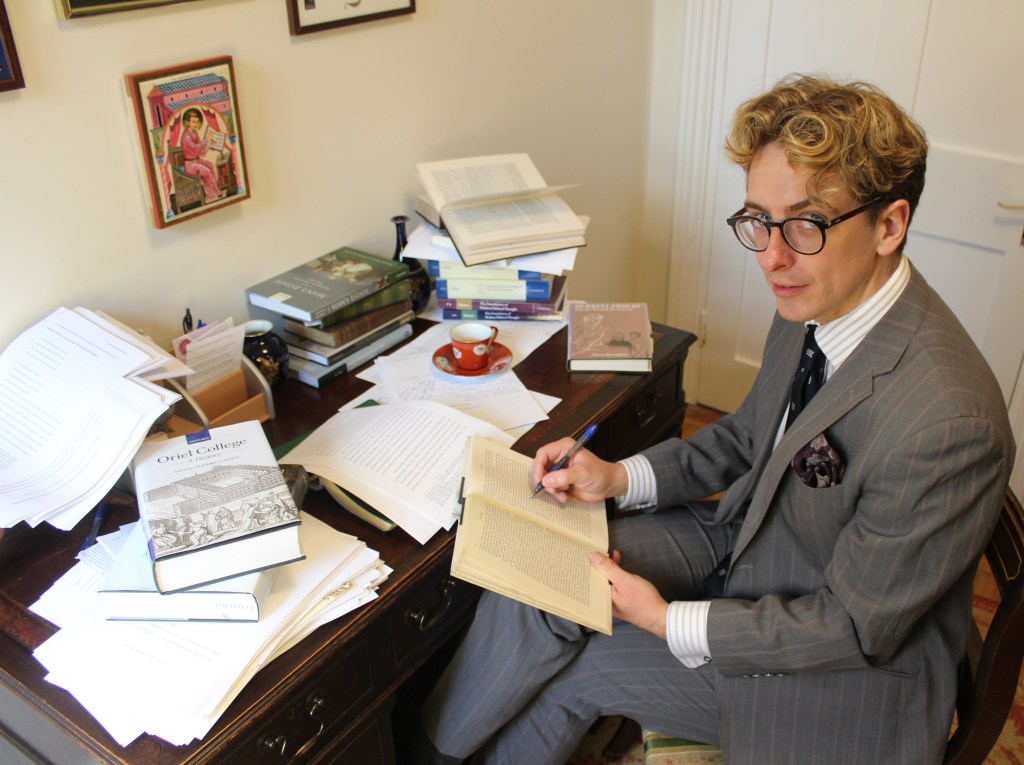
I am a historian of modern Britain (1689-1914), specialising in religious, intellectual and cultural history. My research is particularly concerned with the relationship between ideas and lived experience: how religious and political commitments were formed through friendship, education and sociability; how intellectual affinities became personal and institutional allegiances; and how communities understood, sustained and transmitted their identities across generations.
My doctoral research examined these questions through male friendship and intimacy within the nineteenth-century Oxford Movement. Rather than treating the Movement principally as a succession of theological controversies or through the careers of its best-known figures, my work explored the networks of friendship, affection and spiritual dependence which connected Tractarian clergy and laity. It considered how friendship interacted with masculinity, pastoral practice, and spiritual formation; how personal relationships helped to create and sustain religious identities; and how the memory of those relationships was subsequently used to preserve and recast particular understandings of the Movement and its theological inheritance.
My current research develops this work into a broader study of friendship as a formative force in nineteenth-century religious life. I am particularly interested in the possibility that relationships did more than provide the social context in which religious ideas were discussed: friendship could itself shape theological commitments, influence their development and provide the structures through which they were lived and transmitted. This work consequently brings the history of emotions, masculinities, and intimacies into conversation with the intellectual and ecclesiastical history of Victorian Britain.
These interests form part of a wider concern with the formation and reproduction of British intellectual and elite cultures. My developing research on the Grand Tour examines travel, education, and intimacies as processes of cultural formation. It considers how encounters with continental Europe—with its people, institutions, religious practices, art, architecture and antiquities—shaped British travellers’ intellectual and aesthetic formation, their relationships and networks, and their understanding of their own social and national identities. I am particularly interested in what travellers brought home, both materially and intellectually, and in the ways that continental experience was subsequently translated into faith, collecting, patronage, sociability, taste and cultural life in Britain.
Across these projects, I am interested in the institutions and informal communities through which culture was transmitted: families, friendships, schools and universities, churches, clubs and societies, and networks of travel and correspondence. Although my principal period of research has been the long nineteenth century, these questions increasingly take my work into the eighteenth century and towards a broader history of British elite culture and intellectual formation.
Research Interests
- Modern British history
- Religious and ecclesiastical history
- Intellectual and cultural history
- Friendship, intimacies, and masculinities
- Anglicanism and the Oxford Movement
- British Roman Catholicism
- High Toryism
- British elite culture and sociability
- Travel, education, and the Grand Tour
Teaching Interests
My teaching interests range broadly across modern British history, particularly its political, religious, intellectual and cultural history. I have taught undergraduates for the History Tripos at the University of Cambridge, initially for Paper 5: British Political History, 1688–1886, and subsequently for its successor, Outline 7: British History, c.1750–1980.
I am particularly interested in approaching political history through its wider intellectual, religious, social and cultural contexts. In teaching Outline 7, for example, I encouraged students to connect political developments with questions of industrialisation, demographic and social change, religious belief, national identity, empire and economic transformation.
My more specialised teaching interests arise from my research in nineteenth-century British religious and intellectual history. These include Victorian Britain; Anglicanism and the Oxford Movement; religion and society; friendship, masculinity and sociability; and the relationships between religious, political, and intellectual cultures in the long nineteenth century.
Historical methods and historiography are also central to my teaching. My Cambridge supervisions combined essay discussion with primary-source analysis, historiographical criticism, and training in academic research and writing. I have been particularly interested in helping students understand how historians construct arguments from primary evidence, how historical interpretations emerge and change, and how they might locate their own arguments within wider historiographical debates.
Teaching interests include:
- Modern British history, c.1688–1914
- British political and constitutional history
- Britain in the long eighteenth century
- Victorian Britain
- British religious and ecclesiastical history
- Anglicanism and the Oxford Movement
- Religion, politics, and society
- Nineteenth-century intellectual and cultural history
- Unionism, nationalism, and the British state
- Empire and British political culture
- British elite culture, education, and sociability
- Historical methods and historiography
Doctoral Research
Tractarian Male Friendships, Intimacies, and Identities in Nineteenth-Century England
My doctoral research re-examined the Oxford Movement through the friendships, intimacies and networks that formed and sustained it. Rather than treating friendship principally as an aspect of the private lives of figures such as John Keble, John Henry Newman, Hurrell Froude and Edward Bouverie Pusey, I argued that these relationships were themselves important to the formation of Tractarian religious thought, identity, and allegiance.
Reconstructing friendships extending back through Corpus Christi and Oriel Colleges, Keble’s Southrop reading party, and the Oriel tutorship also challenges the conventional chronology of the Movement. Tractarianism did not suddenly emerge in 1833: many of the relationships and shared intellectual and religious commitments that shaped it had developed considerably earlier. The thesis consequently approached the Movement as a series of overlapping affinities, in which friendship, mentorship, and spiritual intimacy provided settings for theological formation and exchange. Following these affinities beyond Newman’s conversion in 1845 similarly complicates the traditional endpoint of the Movement.
The thesis also examined how friendship shaped the subsequent memory of Tractarianism. Through biographies, memoirs and edited collections—including Froude’s Remains, Coleridge’s Memoir of the Rev. John Keble and Liddon’s Life of Edward Bouverie Pusey—I explored how friends and disciples constructed particular understandings of the Movement for posterity.
More broadly, the research places Tractarianism within nineteenth-century histories of friendship, masculinity, intimacy, and religious identity, using personal relationships as a means of understanding intellectual and theological change.
Appointments and Affiliations
Head of Politics, Harrow School
Affiliated Researcher, Pusey House Centre for Theology, Law, and Culture
Associate Fellow, Royal Historical Society
Life Member, Ecclesiastical History Society

